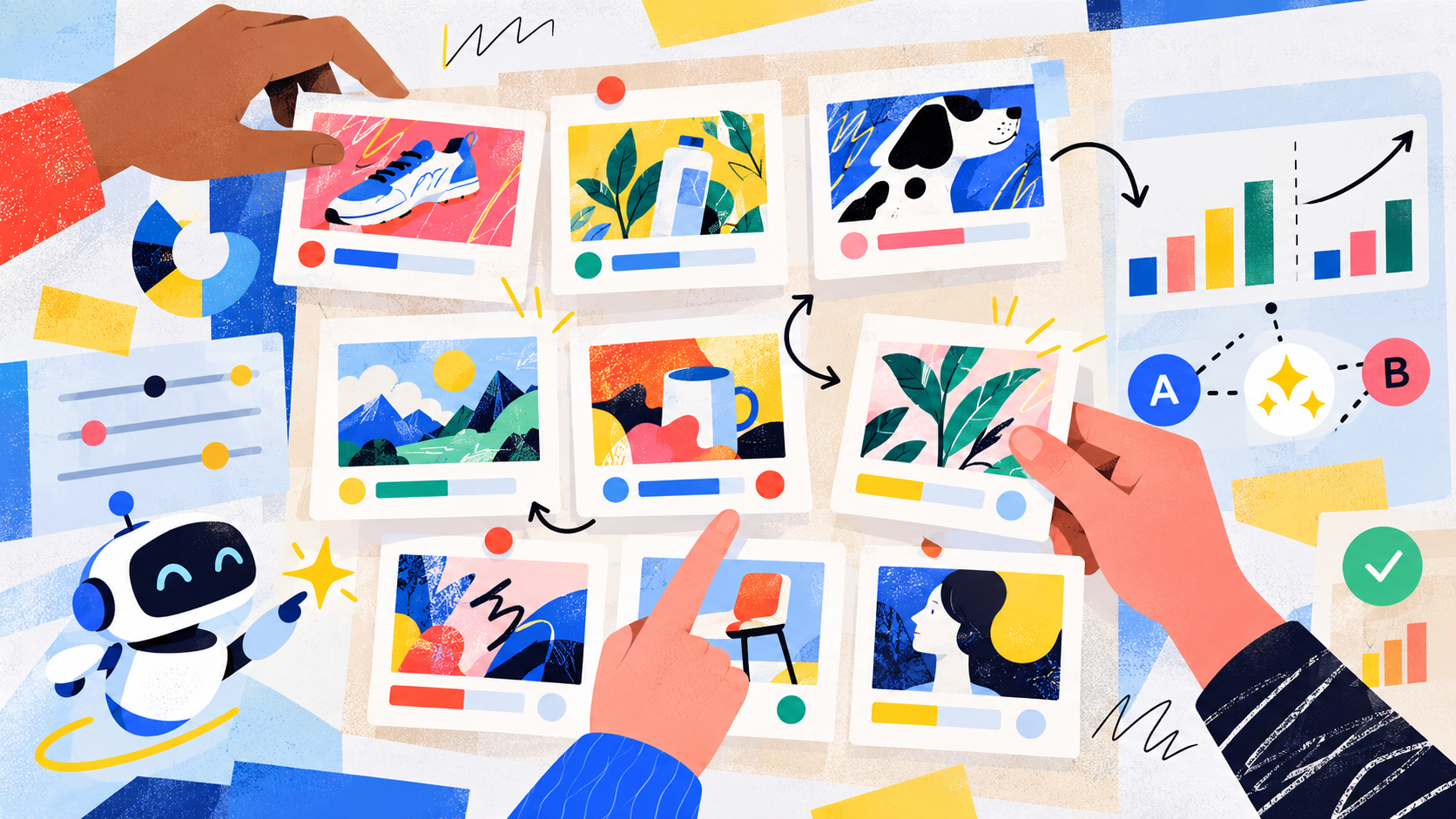
One of the most expensive statements in marketing is: “I think this version looks better.” Personal taste has a role in creative work, but advertising decisions should not depend entirely on internal preference. The customer gets a vote, and creative testing is how marketers listen to that vote.
AI makes testing faster because teams can now generate more variations of headlines, scripts, visuals, layouts, and formats at a lower production cost. The opportunity is not simply to produce more. It is to learn faster.
Start With Big Questions
A common mistake is testing tiny details too early. Marketers may compare a blue button with a green button while ignoring a much more important question: is the offer itself compelling?
Start with variables that can change behavior meaningfully. Test different customer problems, benefits, proof points, hooks, offers, and creative formats. Once the stronger strategic direction is clear, smaller refinements become more useful.
Hooks Deserve Structured Testing
The opening of an ad often determines whether the rest is even seen. A marketing agency could test three approaches:
- “Getting leads is easy. Getting profitable leads is the problem.”
- “Three reasons your Meta Ads leads never become customers.”
- “Before increasing your ad budget, check this.”
All three may promote the same service, but they enter the customer’s attention through different concerns. AI can help generate variations, but the marketer still needs to decide which ideas reflect real customer problems.
Separate Creative Testing From Offer Testing
Excellent creative cannot rescue an irrelevant offer. A campaign might be beautifully designed yet ask the audience to take a weak next step. Consider testing a free audit, calculator, template, demo, trial, industry report, or consultation against one another.
Sometimes the greatest improvement comes from changing what the customer receives, not how the advertisement looks.
Use a Testing Matrix
A simple testing matrix can make experimentation more disciplined. For example, combine three hooks with two visual styles and two calls to action. That creates twelve potential combinations.
You do not need to launch every combination simultaneously. Test in stages. First determine which message works. Then refine the visual execution. Finally, optimize smaller elements.
AI Needs Brand Guardrails
Generative tools make it easy to create dozens of versions. Without rules, those versions can drift away from the brand. Establish approved terminology, tone, visual standards, logo rules, factual boundaries, and prohibited claims before scaling production.
AI should accelerate the brand, not fragment it.
Evaluate Quality Down the Funnel
Cheap leads are not automatically good leads. Creative A may produce a lower cost per lead than Creative B, but if B generates more qualified opportunities and customers, B may be the stronger asset.
Useful metrics include click-through rate, landing-page conversion, cost per lead, qualified-lead rate, sales opportunity rate, customer acquisition cost, and revenue.
Create a Creative Learning Library
Every test should leave behind knowledge. Record winning hooks, losing hooks, effective proof points, common objections, strongest visual styles, customer language, and offer performance.
Over time, this becomes a strategic asset. New campaigns no longer start from zero. The team builds on accumulated evidence.
The Goal Is Better Learning, Not More Variations
AI can generate endless advertisements. That does not mean endless variation is useful. The purpose of testing is to reduce uncertainty about what customers respond to and why.
The best creative systems combine fast production with disciplined learning. AI accelerates the experiment; human strategy decides which questions are worth testing.
Muhammad Al Ori
Business Development and Marketing Strategy